University of Virginia
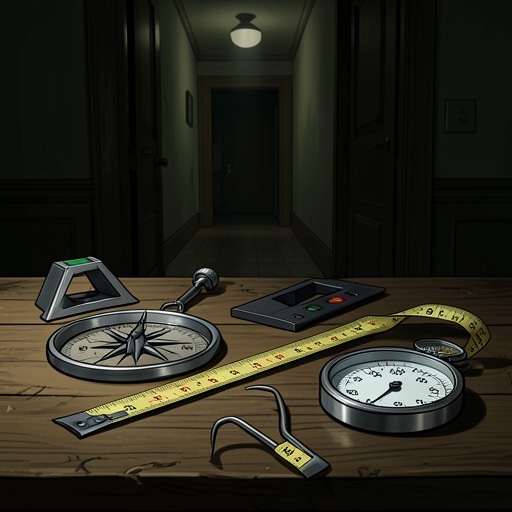
House of LeavesThe University of Virginia enters the narrative as an institutional resource summoned when the house on Ash Tree Lane defeats ordinary explanation. After Will Navidson compares the building plans with measurements taken using a 25-foot Stanley Power Lock and discovers that the interior cannot be reconciled with the exterior, he and Tom Navidson seek engineering assistance connected with the university. The university therefore stands at the boundary between familiar scientific authority and an anomaly that repeatedly exceeds it.
Institutional Role in the Investigation
Will Navidson calls an old friend who teaches engineering at the University of Virginia after he and Tom have spent a day and a half trying to account for the discrepancy. Their initial approach is methodical: they suspect faulty technique, temperature, miscalibrated instruments, warped floors, or another unseen material factor. The decision to consult an engineer reflects their confidence that the problem belongs to a field capable of measurement and correction rather than to the supernatural.
The brothers travel to Charlottesville early the following morning. This movement away from the house temporarily relocates the problem into an academic and technical setting, where specialized knowledge and reliable instruments might restore the ordinary relation between plans, walls, and space. Yet the university’s relevance remains practical rather than ceremonial: it is represented through the expertise of an engineering contact and through the tools used to test the anomaly.
Billy Reston and Technical Authority
The most important figure associated with this technical response is Billy Reston, a gruff engineering authority and an old friend of Will Navidson. Reston is a paraplegic who has spent almost half his life in an aluminum wheelchair, and his professional identity is presented alongside a personal history linking him to Navidson through photography. Navidson first encountered him in an image showing Reston attempting to escape a falling high-voltage wire during an industrial accident in India. The photograph, still hanging in Reston’s office, records both danger and survival while also establishing the history between the two men.
When Will and Tom bring the house’s problem to Reston, he gives the explanation they expect: the equipment must be at fault. He offers a Stanley Beacon level and a Leica laser distance meter, confident that better instruments will quickly eliminate what he calls the apparent ghost in the measurements. His response places the University of Virginia within a recognizable chain of scientific verification: inspect the instruments, improve the measurements, and charge the anomaly with a concrete error.
The Limits of Measurement
The university-associated expertise cannot resolve the house’s contradiction. Tom eventually determines that the interior exceeds the exterior not by one quarter inch, as Will first believed, but by five-sixteenths of an inch. The brothers fill legal pads, napkins, and newspaper margins with calculations, yet no equation can make the fraction disappear. Reston himself repeatedly examines the house, its closet, bookshelves, and measuring equipment, but offers no reasonable explanation for what he describes as a “goddamn spatial rape.”
The failure is not simply a failure of one instrument. The house renders the premise of equal measurement unstable: the exterior should equal the interior, but the building produces a remainder that cannot belong anywhere within conventional geometry. The University of Virginia thus marks the point at which institutional rationality is seriously attempted and visibly strained. Its authority is not mocked as useless; rather, the anomaly becomes more disturbing because competent technical procedures confirm that ordinary explanation is inadequate.
Charlottesville and the Unfinished Inquiry
The connection with the University of Virginia also shapes the narrative’s temporary pauses. Tom postpones his construction obligations while the investigation continues, but by June he can no longer remain at the house. He asks Reston for a lift to Charlottesville so that he can catch a ride to Dulles. The university-associated city becomes a route back into ordinary obligations even though the spatial problem remains unsolved.
Reston’s professional confidence contrasts with the domestic and psychological effects of the house. While he can identify faulty equipment as the likely cause in principle, the changing corridors and rooms produce disorientation severe enough to have physiological consequences, including nausea. The investigation therefore moves from a simple institutional diagnosis toward a recognition that the space affects bodies and perception as well as measurements.
Narrative Significance
In narrative terms, the University of Virginia embodies a form of knowledge built on stable coordinates, repeatable procedures, and the assumption that the world adds up. The house challenges each of those conditions. Its corridors, the Five and a Half Minute Hallway, the Anteroom, the Great Hall, and the Spiral Staircase exist for the explorers, yet their dimensions and layouts can change; other areas fail to reproduce the same pattern twice. No observer sees the entire labyrinth from outside, so understanding must be assembled from within the disorienting system.
The university’s significance therefore lies in the tension between institutional reason and impossible architecture. It supplies the engineers, instruments, vocabulary, and investigative habits needed to establish that the anomaly is real, but it cannot provide a final law governing it. The institution remains a credible promise of explanation precisely as the house turns measurement into another form of uncertainty.